Canelo Alvarez vs Christian Mbilli: New Date, Delay Reason and Title Stakes
The updated Canelo vs Mbilli date, the reported and stated reasons for the delay, the WBC title at stake, and the tactical questions ahead.
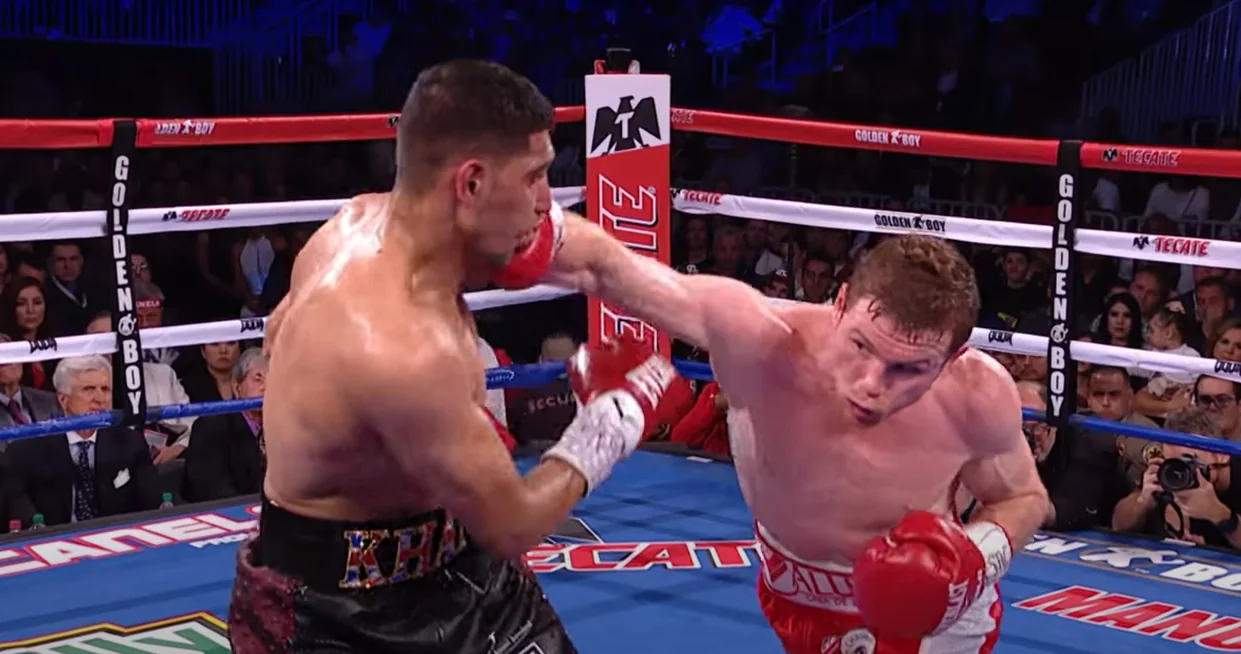
Canelo vs Mbilli Is Now Set for October 31
The new Canelo Alvarez vs Christian Mbilli date is Saturday, October 31, 2026, in Riyadh, Saudi Arabia. Mbilli will defend the WBC super-middleweight world title, which means the familiar billing is reversed: Mbilli is the champion and Canelo is the challenger. That date, city and championship status were still current when this guide was checked on September 16.
| Detail | Current status |
|---|---|
| Date | Saturday, October 31, 2026 |
| Location | Riyadh, Saudi Arabia |
| Title | WBC super-middleweight world championship |
| Champion | Christian Mbilli, 29-0-1 (24 KOs) |
| Challenger | Canelo Alvarez, 63-3-2 (39 KOs) |
The confirmed date, location and championship
The WBC, ESPN and The Ring all identify October 31 in Riyadh as the working event. The Ring's event page lists the WBC belt and the same records shown above. No specific arena is stated here because the city is the stable part of the announcement and a venue can be finalized or changed separately. The same caution applies to a displayed broadcast-start time: an event window is not a guaranteed main-event ringwalk.
It is also important to name the stakes precisely. Mbilli holds the WBC belt at 168 pounds. This is not an undisputed championship fight, and a Canelo victory would not reunify all four major titles. It would make him WBC champion again and begin, rather than complete, any attempt to rebuild his former position at super middleweight.
What changed from the original September 12 plan
The bout was initially set for September 12 in Riyadh. On June 27, The Ring reported that it had been moved to late October, but there was not yet a precise replacement day. Canelo then publicly named October 31 on July 22, and the WBC and major boxing outlets carried the updated date the following day.
That makes the practical sequence straightforward: September 12 was the original booking, late October was the first reported replacement window, and October 31 became the confirmed new date. The change adds about seven weeks to each camp and leaves both men approaching a 13-month gap between bouts. It does not, by itself, tell us why the move happened. The reason requires a separate distinction between what Canelo personally said and what earlier scheduling reports observed.
Why Canelo vs Mbilli Was Delayed
The most accurate answer requires two separate sentences. Canelo said private family matters delayed the start of his training camp. Earlier reporting observed that moving his fight also cleared September 12 for Ryan Garcia vs Conor Benn. The first is the fighter's stated reason; the second is a scheduling consequence. Treating them as interchangeable makes a simple timeline sound more certain than the evidence allows.
Canelo's stated family reason
When Canelo announced the Halloween date on July 22, he explained that problems in his family needed attention. He said he is normally disciplined and organized about camp, but was not ready to enter one while that was unresolved. He also said the matter was then in order and he was ready to train. ESPN, Boxing News and L'Équipe all carried that explanation.
That is as far as a responsible account should go. Canelo did not publicly describe the private situation, and there is no need to invent one. He did not blame a new injury or a promotional breakdown. His explanation was that his preparation could not begin on the normal timetable, so he requested or accepted a postponement rather than forcing a shortened camp for a pressure fighter.
What is established
Family matters delayed Canelo's camp; the bout moved from September 12 to October 31; the city remained Riyadh.
What is not established
The private details, every promoter-level discussion, or proof that a single commercial consideration caused the change.
The Garcia-Benn scheduling effect is not the same as the cause
On June 27, before Canelo supplied his explanation, The Ring reported that Canelo-Mbilli would move to late October and that the shift paved the way for Garcia-Benn to take September 12 in Las Vegas. The date matters commercially because it sits near Mexican Independence Day, a weekend Canelo has helped turn into premium boxing territory.
The sequence is easy to overstate. Garcia-Benn did occupy the open date, and avoiding two major products on the same day is logical. But that does not prove the second event created Canelo's family issue or was the only reason a new date became necessary. The careful formulation is that Canelo supplied the personal explanation, while the reshuffled calendar benefited Garcia-Benn and the broadcasters around it. Anything stronger would be analysis presented as fact.
How Mbilli says the extra wait affected him
Mbilli did not publicly turn the postponement into a grievance. He initially told L'Équipe that the news surprised him but did not disappoint him; after waiting years for a Canelo opportunity, another month was manageable. He later explained that a bereavement close to him made the extra time unexpectedly useful, because it allowed him to handle life outside the gym before beginning pre-camp.
By early September, Mbilli's public position was still calm: one or several additional months did not erase the opportunity or his expectation of winning. That does not mean a longer camp is automatically better. A fighter who had already built toward September 12 must reset hard sparring, recovery, strength work and weight reduction so that his sharpest week lands in late October. Staying near fighting shape for too long can flatten speed and enthusiasm; backing off too far can waste the head start.
Both teams therefore face the same professional task with different circumstances: rebuild the training cycle instead of merely adding seven more hard weeks. The delay gave each man time. Whether either camp used that time well will show in the pace, reactions and decision-making of the opening rounds.
The WBC Super Middleweight Title Stakes
The belt story is unusual but not ambiguous. Christian Mbilli is the WBC's recognized champion at 168 pounds, even though he did not win the full title by beating another full champion in the ring. Canelo once held every major belt in the division, but he now needs to take one back from Mbilli. A win would restore Canelo as WBC champion; it would not instantly restore his former undisputed status.
How Mbilli became full WBC champion
Mbilli's route began with an interim championship. He stopped Maciej Sulecki in the first round in Quebec City on June 27, 2025 to win that version of the WBC title. An interim belt is designed to keep a division moving when the full champion is unavailable. It places its holder near the front of the organization's succession plan, but it is not the same status as the full world championship.
His first defense produced more questions than separation. On September 13, 2025, Mbilli and Lester Martinez fought ten hard rounds to a split draw. Patricia Morse Jarman had Martinez ahead 97-93, Chris Migliore scored 96-94 for Mbilli, and Glenn Feldman returned 95-95. Because it was a draw, Mbilli retained the interim belt and remained unbeaten at 29-0-1.
The full title changed hands above him that same night when Terence Crawford defeated Canelo. Crawford later announced his retirement and ceased to hold the WBC belt; ESPN also reported that the organization stripped him after a sanctioning-fee payment dispute. On January 27, 2026, the WBC elevated Mbilli from interim to full champion. That is an official administrative route to a championship, not a retroactive win over Crawford or Martinez.
What Canelo lost to Crawford and can regain here
Crawford beat Canelo by unanimous decision at Allegiant Stadium. The official scores were 115-113, 115-113 and 116-112. Canelo therefore lost the undisputed super-middleweight championship: the WBA, WBC, IBF and WBO belts that had made one champion answer every major sanctioning-body claim.
The October 31 task is narrower. Mbilli owns the WBC piece. If Canelo beats him, he will recover that one major title and again have the bargaining power that comes with being a reigning champion. He will not automatically possess the other three belts or The Ring championship, and the Crawford defeat will remain on his record. Language such as “returns to undisputed” or “wins all his belts back” would be inaccurate.
Why a first defense against Canelo is an unusual proving ground
An elevated champion often gets a first defense that allows the new status to settle. Mbilli instead faces the division's most recognizable former champion after more than a year out of the ring. It is a commercially enormous opportunity and an unforgiving sporting test. The belt makes him champion on paper; beating Canelo would give his reign the signature in-ring victory that an elevation cannot supply.
That distinction should not become an excuse to dismiss Mbilli. He earned the interim position through activity and a first-round win, survived a demanding draw against Martinez, and was promoted under the WBC's rules when the title became available. Nor should official recognition end the debate. He has not yet defeated an opponent with Canelo's championship experience, defensive craft or ability to punish mistakes at close range.
For Canelo, the psychological pressure works in reverse. He is expected to behave like the established champion without being one. If he wins, the result begins a new title reign rather than merely resuming an old one. If he loses, Mbilli will have moved from administrative champion to the man who denied Canelo's first attempt to rebuild after Crawford. That is why the belt matters beyond the green strap itself.
The Tactical Fight: Pressure Against Counters
This matchup is often reduced to four words: Mbilli's pressure, Canelo's counters. That is the right starting point but an incomplete prediction. Pressure succeeds only if it closes exits and creates clean offense; counterpunching succeeds only if it interrupts the attacker often enough to change his behavior. The winner will be the fighter who controls the moments before and after each exchange.
Mbilli's pressure, volume and body work
Mbilli is not a long-range stylist trying to steal rounds with single jabs. He advances behind compact steps, throws in clusters and keeps his torso close enough to continue when an opponent reaches the ropes. His conditioning lets him repeat hard combinations rather than admire one punch. That is the real danger for a lower-output veteran: even blocked shots can hold him in place while the next punch finds the body or travels around the guard.
The Lester Martinez draw also showed the cost. Martinez met Mbilli's entries with uppercuts and straight rights, sometimes landing several counters before Mbilli completed his own series. Mbilli still forced the action and made Martinez work, but he acknowledged afterward that he needed better defense and cleaner transitions between defending and attacking. Against Canelo, walking through one counter to land three punches is a possible trade; walking through the same counter every round is a tactical failure.
Mbilli therefore needs pressure with shape. The lead foot must take away Canelo's preferred exit before the shoulders square up. A jab to the chest can freeze a slip more reliably than a headhunting jab. Body shots should finish a combination when Canelo's elbows rise, not begin from so far away that the challenger can see the entry. The goal is to make Canelo work for every quiet second without presenting the same doorway each time.
Canelo's counterpunching and pace control
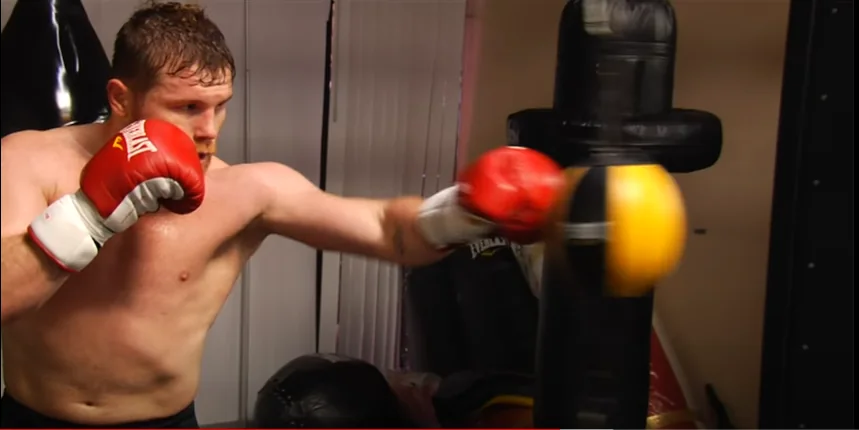
Canelo does not need to run from pressure to neutralize it. At his best, he gives a small step, catches or slips the first punch and answers into the opening. His high guard reduces the target while his torso movement changes the angle of impact. A short right uppercut can meet a forward head; a left hook can catch the attacker after a right hand; a right to the body can make the next entry arrive with less conviction.
The risk is selectivity. Clean counters are memorable, but rounds last three minutes. If Canelo spends long stretches reading behind the guard and releases only one punch at a time, Mbilli can own the geography and activity even without landing every shot cleanly. Judges do not award a round simply because one fighter produced its best punch. Canelo must turn some defensive successes into two- and three-punch answers, then move before Mbilli restarts.
Pace control also means choosing when to stand his ground. Giving away the ropes too cheaply lets Mbilli shorten the ring. Holding the center every second can turn the fight into the younger man's conditioning contest. Canelo's useful rhythm is likely to alternate: make Mbilli reset in open space, punish a predictable rush, then pivot or clinch before the champion can build a second combination.
The three exchanges most likely to decide the fight
- 1. Jab against the first step. Mbilli needs his jab to occupy Canelo while his feet close distance. Canelo can jab the chest or shoulder to disturb that step. Whoever wins this small contest decides whether the exchange begins at Mbilli's range or Canelo's.
- 2. Body entry against the uppercut. Mbilli's body work can slow Canelo and keep his output high, but lowering the level on a straight path exposes the center. Martinez repeatedly found uppercuts there. Canelo's shorter, heavier version could make Mbilli hesitate—if his timing survives the layoff.
- 3. The beat after Mbilli finishes. A combination does not end when the last punch lands; it ends when the attacker leaves safely. If Mbilli pauses square after three or four shots, Canelo can hook as the guard relaxes. If Mbilli exits on an angle or immediately re-jabs, he can deny that familiar counter.
Those are editorial projections from each man's established tendencies, not leaked game plans. A sharp Canelo may make Mbilli's pressure look reckless. A disciplined Mbilli may turn Canelo's patience into inactivity. The most revealing statistic will not be a raw punch total, but how often each fighter completes his preferred exchange and leaves the other unable to answer.
The Layoff Questions for Both Fighters
October 31 will arrive roughly 13 and a half months after both fighters last competed. That symmetry does not make the layoffs identical. Canelo returns from a clear defeat and left-elbow surgery; Mbilli returns from a draw that tested his engine and exposed defensive openings. The early rounds should be read as evidence, not as a referendum on age or a medical diagnosis.
Canelo after the Crawford loss and elbow surgery
Canelo's team said loose bodies were removed from his left elbow in an arthroscopic procedure scheduled for October 23, 2025. At the time, the stated prognosis was excellent and light training was expected after four to six weeks. By 2026 he was back in camp, but an optimistic team statement and workout footage cannot independently prove how a joint will respond to twelve rounds of blocking, punching and clinch pressure.
The useful evidence will be functional. Does Canelo establish his jab without protecting the arm? Does the left hook arrive naturally after a right hand? Can he throw combinations rather than one clean counter and a long reset? When Mbilli leans and works at close range, does Canelo frame, clinch and punch with both sides comfortably? None of those signs diagnoses his elbow; together they show whether the repaired arm participates in his complete offense.
The Crawford result adds a separate mental and tactical question. Canelo could not consistently solve a faster opponent who changed range and delivered combinations before exiting. Mbilli presents a very different target, but Canelo still has to trust his reads after losing a clear unanimous decision. If he begins slowly, that may be normal measurement after a layoff. If he repeatedly sees the opening and cannot release, Mbilli's activity can make the hesitation expensive.
Mbilli after the Lester Martinez draw
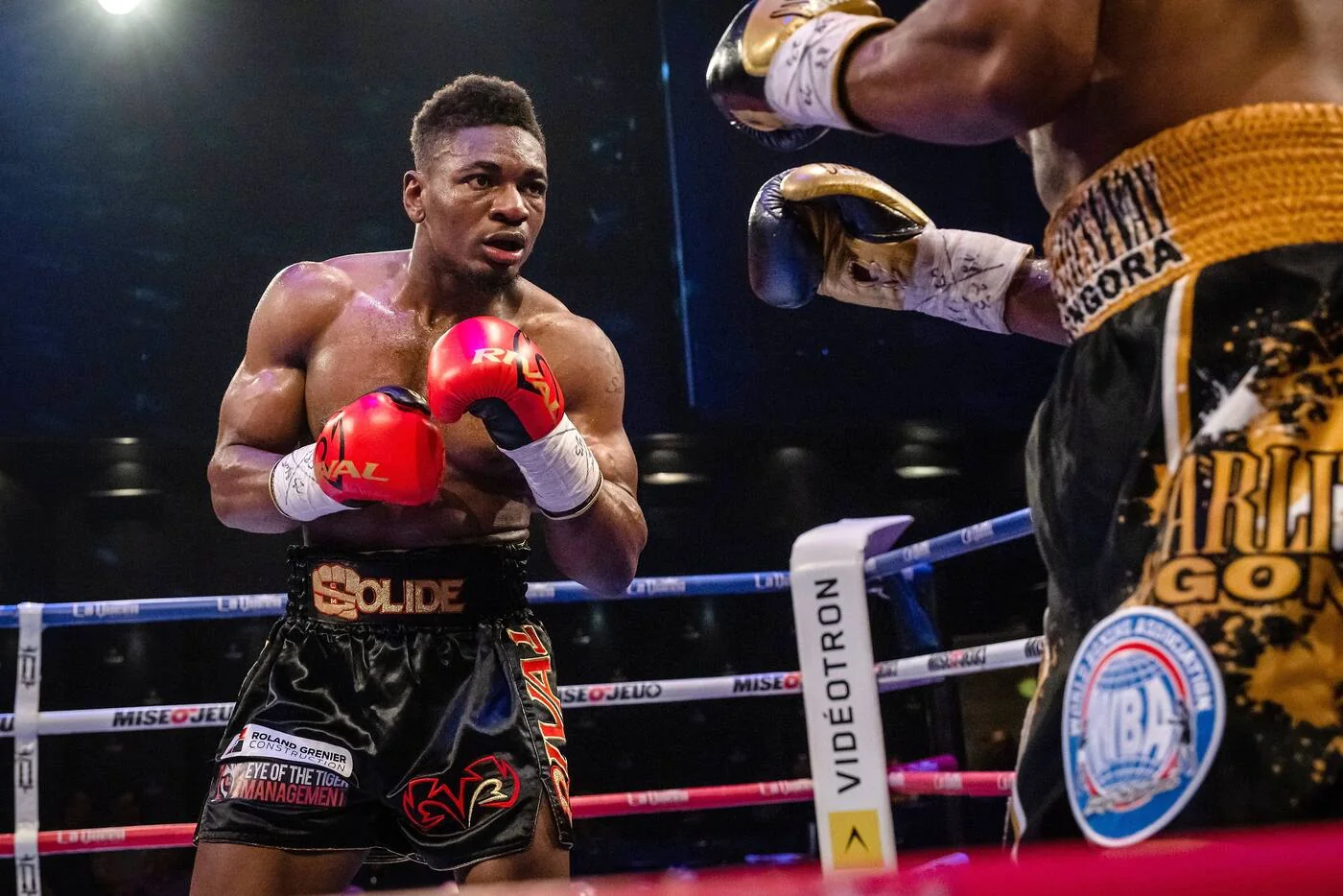
Mbilli's draw was not a failure of courage or conditioning. He pressed across ten fast rounds and kept responding when Martinez landed. It was, however, a clear lesson about the cost of predictable entries. Uppercuts split the middle, straight rights interrupted advances, and Martinez sometimes completed multiple counters before Mbilli restored his guard. One judge saw Martinez winning 97-93.
Mbilli later identified better defense and smoother transitions between defense and attack as priorities. That diagnosis matters because it is more specific than promising to “be smarter.” Against Canelo, improvement should appear as a safer head position behind the first step, a guard that returns before the feet square up, and an exit or immediate re-jab after the final power shot. The champion does not need to abandon pressure; he needs to remove its repetitive cues.
His conditioning team says the long rest left him fresh rather than deconditioned and that training was being built toward repeat power over twelve rounds. That is encouraging camp testimony, not independent proof. Fight-night evidence will come when Canelo lands a counter: does Mbilli rush to recover the moment, or reset and rebuild the pressure? A younger fighter can be physically ready and still lose minutes through impatience.
“Ring rust” is therefore too blunt an explanation on its own. Watch distance, decision speed and recovery between exchanges. Canelo must show that surgery and defeat have not reduced his willingness to release punches. Mbilli must show that a long period outside competition improved his craft without dulling the pressure that made him champion. The first three rounds will begin answering both questions.
What Fans Should Check Before Fight Night
The date and title are settled enough to plan around; the viewing terms, running order and ringwalk are not equally fixed. The Ring currently lists the October 31 event on DAZN PPV and displays a 1 p.m. ET start, but that is an event listing rather than a promise that Canelo and Mbilli will enter the ring at that hour.
Broadcast and start-time details can vary by market
DAZN is the reported platform, but rights and purchase models remain territorial. One country may show a separate PPV price, another may attach the event to a particular subscription tier, and a third may not display identical terms. Open the DAZN event tile while signed into the account and country where you will watch. Do not use a price, free trial or package described for another market as proof of your own access.
The same discipline applies to time. `Coverage starts`, `main card starts` and `estimated ringwalk` describe different moments. Support bouts can finish in one round or use every scheduled round; medical checks, television breaks and ceremonies can also change the pace. Convert the published event time to your local zone, then follow the live card instead of setting one alarm for an unofficial main-event estimate.
Our legal boxing viewing guide explains how to verify the rights holder and purchase route without following unauthorized streams or misleading `live` videos.
The undercard and running order remain moving parts
The event has been promoted with a `Mexico vs. the World` theme. Boxing News reported agreements for Lindolfo Delgado vs Arthur Biyarslanov for a vacant IBF super-lightweight title and Rafael Espinoza vs Lorenzo Parra for the WBO featherweight title. The same report described Jaime Munguia only as a possibility. Those distinctions matter: a source-reported agreement, a promoter announcement and a commission-approved bout are three different levels of certainty.
Even a confirmed support bout can move position or leave the card after a failed medical, travel issue, licensing decision or weigh-in problem. A poster published weeks earlier cannot show those changes. Check boxing tonight on the day, then confirm the running order with the official broadcaster or promoter notice.
A fight-week verification checklist
- 1. Official event page: confirm October 31, Riyadh, the named venue and the current broadcast tile.
- 2. Your market: verify local price, subscription requirement, replay access and supported device.
- 3. Weigh-in: confirm both main-event fighters made the 168-pound championship limit and note any bout changes.
- 4. Final running order: separate prelims, main-card start and the estimated headline window.
- 5. Local time: convert once from the broadcaster's zone and check whether the date rolls into the next morning.
- 6. Live progress: follow completed bouts rather than treating an estimated ringwalk as an appointment.
That checklist is the right final word because this is still a future fight. October 31 is the new target, family matters are Canelo's stated reason for the delay, and Mbilli's WBC belt is the prize. Everything more granular should be allowed to update as the event moves from announcement to weigh-in to opening bell.
Keep reading
Related boxing articles
Fight Guides
Why UNLV Moved a Football Game for Canelo–Crawford at Allegiant Stadium
By Boxing Schedule Editorial TeamFight Guides
Boxing Ringwalks and NFL Kickoffs: A Sports Viewing Guide
By Boxing Schedule Editorial TeamFight Guides
Join the conversation
Comments
Comments are reviewed before publication. Keep the discussion useful and focused on boxing.
Sign in with Google to comment
Your public comment shows your account name. Your email address is not displayed.
Commenting as
Loading comments…